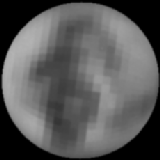
Pluto is the farthest planet from the Sun (usually) and by far the smallest. Pluto is smaller than seven of the solar system's moons (the Moon, Io, Europa, Ganymede, Callisto, Titan and Triton).
orbit: 5,913,520,000 km (39.5 AU) from the Sun (average)
diameter: 2274 km
mass: 1.27e22 kg
In Roman mythology, Pluto (Greek: Hades) is the god of the underworld. The planet received this name (after many other suggestions) perhaps because it's so far from the Sun that it is in perpetual darkness and perhaps because "PL" are the initials of Percival Lowell.
Pluto was discovered in 1930 by a fortunate accident. Calculations which later turned out to be in error had predicted a planet beyond Neptune, based on the motions of Uranus and Neptune. Not knowing of the error, Clyde W. Tombaugh at Lowell Observatory in Arizona did a very careful sky survey whichturned up Pluto anyway.
After the discovery of Pluto, it was quickly determined that Pluto was too small to account for the discrepancies in the orbits of the other planets. The search for Planet X continued but nothing was found. Nor is it likely that it ever will be: the discrepancies vanish if the mass of Neptune determined from the Voyager 2 encounter with Neptune is used. There is no tenth planet.
Pluto is the only planet that has not been visited by a spacecraft. Even the Hubble Space Telescope can resolve only the largest features on itssurface.
Pluto's radius is not well known. JPL's value of 1137 is given with an error of +/-8, almost one percent.
There are some who think Pluto would be better classified as a large asteroid or comet rather than as a planet. Some consider it to be the largest of the KuiperBelt objects (also known as Trans-Neptunian Objects). There is considerable merit to the later position, but historically Pluto has been classified as a planet and it is likely to remain so.
Pluto's orbit is highly eccentric. At times it is closer to the Sun than Neptune (as it was from January 1979 thru February 11 1999). Pluto rotates in the oppositedirection from most of the other planets.
Pluto is locked in a 3:2 resonance with Neptune; i.e. Pluto's orbital period is exactly 1.5 times longer than Neptune's. Its orbital inclination is also much higher than the other planets'. Thus though it appears that Pluto's orbit crosses Neptune's, it really doesn't and they will never collide. (Here is a more detailed explanation.)
Like Uranus, the plane of Pluto's equator is at almost right angles to the plane of its orbit.
The surface temperature on Pluto is not well known but is probably between 35 and 45 Kelvins (-228 to -238 C).
Pluto's composition is unknown, but its density (about 2 gm/cm3) indicates that it is probably a mixture of 70% rock and 30% water ice much like Triton. Thebright areas of the surface seem to be covered with ices of nitrogen with smaller amounts of (solid) methane, ethane and carbon monoxide. The composition of the darker areas of Pluto's surface is unknown but may be due to primordial organic material or photochemical reactions driven by cosmic rays.
Mercury | Venus | Earth | Mars | Jupiter | Saturn | Uranus | Neptune | Pluto
