
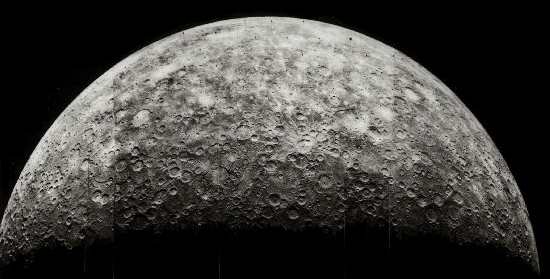
Mercury is the closest planet to the Sun and the eighth largest. Mercury is smaller in diameter than Ganymede and Titan but more massive.
orbit: 57,910,000 km (0.38 AU) from Sun
diameter: 4,880 km
mass: 3.30e23 kg
In Roman mythology Mercury is the god of commerce, travel and thievery, the Roman counterpart of the Greek god Hermes, the messenger of the Gods. Theplanet probably received this name because it moves so quickly across the sky.
Mercury has been known since at least the time of the Sumerians (3rd millennium BC). It was given two names by the Greeks: Apollo for its apparition as amorning star and Hermes as an evening star. Greek astronomers knew, however, that the two names referred to the same body. Heraclitus even believed thatMercury and Venus orbit the Sun, not the Earth.
Mercury has been visited by only one spacecraft, Mariner 10. It flew by three times in 1974 and 1975. Only 45% of the surface was mapped (and, unfortunately, it is too close to the Sun to be safely imaged by HST).
Temperature variations on Mercury are the most extreme in the solar system ranging from 90 K to 700 K. The temperature on Venus is slightly hotter but very stable.
Mercury is in many ways similar to the Moon: its surface is heavily cratered and very old; it has no plate tectonics. On the other hand,
Mercury is much denser than the Moon (5.43 gm/cm3 vs 3.34). Mercury is the second densest major body in the solar system, after Earth.
Actually Earth's density is due in part to gravitational compression; if not for this, Mercury would be denser than Earth. This indicates that
Mercury's dense iron core is relatively larger than Earth's, probably comprising the majority of the planet. Mercury therefore has only arelatively thin silicate mantle and crust.
Mercury's interior is dominated by a large iron core whose radius is 1800 to 1900 km. The silicate outer shell (analogous to Earth's mantle and crust) is only 500 to 600 km thick. At least some of the core is probably molten.
Mercury actually has a very thin atmosphere consisting of atoms blasted off its surface by the solar wind. Because Mercury is so hot, these atoms quickly escape into space. Thus in contrast to the Earth and Venus whose atmospheres are stable, Mercury's atmosphere is constantly being replenished.
Mercury | Venus | Earth | Mars | Jupiter | Saturn | Uranus | Neptune | Pluto
