
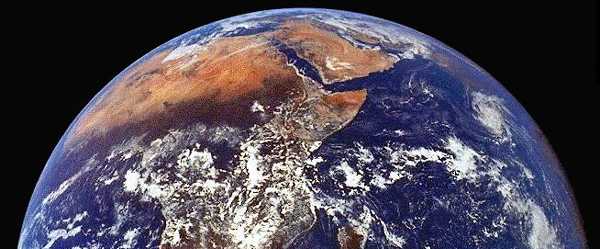
Earth is the third planet from the Sun and the fifth largest:
Orbit: 149,600,000 km (1.00 AU) from Sun
Diameter: 12,756.3 km
Mass: 5.9736e24 kg
Earth is the only planet whose English name does not derive from Greek/Roman mythology. The name derives from Old English and Germanic. There are, ofcourse, hundreds of other names for the planet in other languages. In Roman Mythology, the goddess of the Earth was Tellus - the fertile soil (Greek: Gaia, terra mater - Mother Earth).
Earth, of course, can be studied without the aid of spacecraft. Nevertheless it was not until the twentieth century that we had maps of theentire planet. Pictures of the planet taken from space are of considerable importance; for example, they are an enormous help in weatherprediction and especially in tracking and predicting hurricanes. And they are extraordinarily beautiful.
The Earth is divided into several layers which have distinct chemical and seismic properties (depths in km):
0- 40 Crust
40- 400 Upper mantle
400- 650 Transition region
650-2700 Lower mantle
2700-2890 D'' layer
2890-5150 Outer core
5150-6378 Inner core
The crust varies considerably in thickness, it is thinner under the oceans, thicker under the continents. The inner core and crust are solid; the outer core and mantle layers are plastic or semi-fluid. The various layers are separated by discontinuities which are evident in seismic data; the best known of these is the Mohorovicic discontinuity between the crust and upper mantle.
Most of the mass of the Earth is in the mantle, most of the rest in the core; the part we inhabit is a tiny fraction of the whole (values below x10^24 kilograms):
atmosphere = 0.0000051
oceans = 0.0014
crust = 0.026
mantle = 4.043
outer core = 1.835
inner core = 0.09675
The core is probably composed mostly of iron (or nickel/iron) though it is possible that some lighter elements may be present, too. Temperatures at the center of the core may be as high as 7500 K, hotter than the surface of the Sun. The lower mantle is probably mostly silicon, magnesium and oxygen with some iron, calcium and aluminum. The upper mantle is mostly olivene and pyroxene (iron/magnesium silicates), calcium and aluminum. We know most of this only from seismic techniques; samples from the upper mantle arrive at the surface as lava from volcanoes but the majority of the Earth is inaccessible. The crust is primarily quartz (silicon dioxide) and other silicates like feldspar. Taken as a whole, the Earth's chemical composition (by mass) is:
34.6% Iron
29.5% Oxygen
15.2% Silicon
12.7% Magnesium
2.4% Nickel
1.9% Sulfur
0.05% Titanium
The Earth is the densest major body in the solar system.
The Earth's surface is very young. In the relatively short (by astronomical standards) period of 500,000,000 years or so erosion and tectonic processes destroyand recreate most of the Earth's surface and thereby eliminate almost all traces of earlier geologic surface history (such as impact craters). Thus the very early history of the Earth has mostly been erased. The Earth is 4.5 to 4.6 billion years old, but the oldest known rocks are about 4 billion years old and rocks older than 3 billion years are rare. The oldest fossils of living organisms are less than 3.9 billion years old. There is no record of the critical period when life was first getting started.
71 Percent of the Earth's surface is covered with water. Earth is the only planet on which water can exist in liquid form on the surface (though there may be liquid ethane or methane on Titan's surface and liquid water beneath the surface of Europa). Liquid water is, of course, essential for life as we know it. The heat capacity of the oceans is also very important in keeping the Earth's temperature relatively stable.
The Earth's atmosphere is 77% nitrogen, 21% oxygen, with traces of argon, carbon dioxide and water. There was probably a very much larger amount of carbon dioxide in the Earth's atmosphere when the Earth was first formed, but it has since been almost all incorporated into carbonate rocks and to a lesser extent dissolved into the oceans and consumed by living plants. Plate tectonics and biological processes now maintain a continual flow of carbon dioxide from the atmosphere to these various "sinks" and back again. The tiny amount of carbon dioxide resident in the atmosphere at any time is extremely important to the maintenance of the Earth's surface temperature via the greenhouse effect. The greenhouse effect raises the average surface temperature about 35 degrees C above what it would otherwise be (from a frigid -21 C to a comfortable +14 C); without it the oceans would freeze and life as we know it would be impossible.
Mercury | Venus | Earth | Mars | Jupiter | Saturn | Uranus | Neptune | Pluto
