
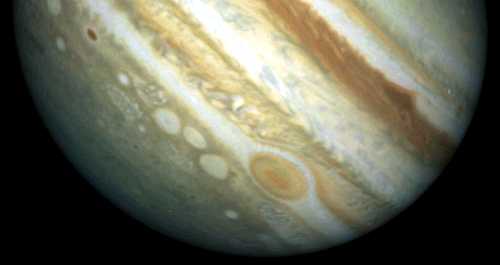
Jupiter is the fifth planet from the Sun and by far the largest. Jupiter is more than twice as massive as all the other planets combined (318 timesEarth).
orbit: 778,330,000 km (5.20 AU) from Sun
diameter: 142,984 km (equatorial)
mass: 1.900e27 kg
Jupiter (a.k.a. Jove; Greek Zeus) was the King of the Gods, the ruler of Olympus and the patron of the Roman state. Zeus was the son of Cronus (Saturn).
Jupiter is the fourth brightest object in the sky (after the Sun, the Moon and Venus; at some times Mars is also brighter). It has been known since prehistoric times.
Jupiter was first visited by Pioneer 10 in 1973 and later by Pioneer 11, Voyager 1, Voyager 2 and Ulysses. The spacecraft Galileo is currently in orbit around Jupiter and will be sending back data for at least the next two years.
Jupiter is about 90% helium (by numbers of atoms, 75/25% by mass) with traces of methane, water, ammonia and "rock". This is veryclose to the composition of the primordial Solar Nebula from which the entire solar system was formed. Saturn has a similar composition, but Uranus and Neptune have much less hydrogen and helium.
Jupiter probably has a core of rocky material amounting to something like 10 to 15 Earth-masses.
Three distinct layers of clouds are believed to exist consisting of ammonia ice, ammonium hydrosulfide and a mixture of ice and water. However, the preliminary results from the Galileo probe show only faint indications of clouds (one instrument seems to have detected the topmost layer while another may have seen the second). But the probe's entry point (left) was unusual -- Earth-based telescopic observations and more recent observations by the Galileo orbiter suggest that the probe entry site may well have been one of the warmest and least cloudy areas on Jupiter at that time.
Data from the Galileo atmospheric probe also indicate that there is much less water than expected. The expectation was that Jupiter's atmosphere would contain about twice the amount of oxygen (combined with the abundant hydrogen to make water) as the Sun. But it now appears that the actual concentration much less than the Sun's. Also surprising was the high temperature and density of the uppermost parts of the atmosphere.
The vivid colors seen in Jupiter's clouds are probably the result of subtle chemical reactions of the trace elements in Jupiter's atmosphere, perhaps involving sulfur whose compounds take on a wide variety of colors, but the details are unknown. The colors correlate with the cloud's altitude: blue lowest, followed by browns and whites, with reds highest. Sometimes we see the lower layers through holes in the upper ones.
Jupiter radiates more energy into space than it receives from the Sun. The interior of Jupiter is hot: the core is probably about 20,000 K. The heat is generated by the Kelvin-Helmholtz mechanism, the slow gravitational compression of the planet. (Jupiter does NOT produce energy by nuclear fusion as in the Sun; it is much too small and hence its interior is too cool to ignite nuclear reactions.) This interior heat probably causes convection deep within Jupiter's liquid layers and is probably responsible for the complex motions we see in the cloud tops. Saturn and Neptune are similar to Jupiter in this respect, but oddly, Uranus is not. Jupiter is just about as large in diameter as a gas planet can be. If more material were to be added, it would be compressed by gravity such that the overall radius would increase only slightly. A star can be larger only because of its internal (nuclear) heat source. (But Jupiter would have to be at least 80 times more massive to become a star.)
Jupiter has rings like Saturn's, but much fainter and smaller. They were totally unexpected and were only discovered when two of the Voyager 1 scientists insisted that after traveling 1 billion km it was at least worth a quick look to see if any rings might be present. Everyone else thought that the chance of finding anything was nil, but there they were. It was a major coup. They have since been imaged in the infra-red from ground-based telescopes and by Galileo.
Unlike Saturn's, Jupiter's rings are dark (albedo about .05). They're probably composed of very small grains of rocky material. Unlike Saturn's rings, they seem to contain no ice.
Particles in Jupiter's rings probably don't stay there for long (due to atmospheric and magnetic drag). The Galileo spacecraft found clear evidence that the rings are continuously resupplied by dust formed by micrometeor impacts on the four inner moons, which are very energetic because of Jupiter's large gravitational field. The inner halo ring is broadened by interactions with Jupiter's magnetic field.
