
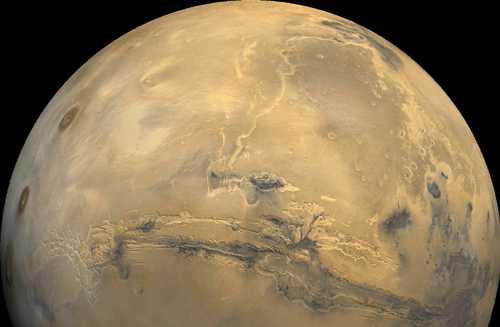
Mars is the fourth planet from the Sun and the seventh largest:
orbit: 227,940,000 km (1.52 AU) from Sun
diameter: 6,794 km
mass: 6.4219e23 kg
Mars (Greek: Ares) is the god of War. The planet probably got this name due to its red color; Mars is sometimes referred to as the Red Planet. (An interestingside note: the Roman god Mars was a god of agriculture before becoming associated with the Greek Ares; those in favor of colonizing and terraforming Mars may prefer this symbolism.) The name of the month March derives from Mars.
Mars has been known since prehistoric times. It is still a favorite of science fiction writers as the most favorable place in the Solar System (other than Earth!) for human habitation. But the famous "canals" "seen" by Lowell and others were, unfortunately, just as imaginary as Barsoomian princesses.
The first spacecraft to visit Mars was Mariner 4 in 1965. Several others followed including Mars 2, the first spacecraft to land on Mars and the two Viking landers in 1976 (left). Ending a long 20 year hiatus, Mars Pathfinder landed successfully on Mars on 1997 July 4 (right).
Mars' orbit is significantly elliptical. One result of this is a temperature variation of about 30 C at the subsolar pointbetween aphelion and perihelion. This has a major influence on Mars' climate. While the average temperature on Mars is about 218 K (-55 C, -67 F), Martian surface temperatures range widely from as little as 140 K (-133 C, -207 F) at the winter pole to almost 300 K (27 C, 80 F) on the day side during summer.
Though Mars is much smaller than Earth, its surface area is about the same as the land surface area of Earth.
There is very clear evidence of erosion in many places on Mars including large floods and small river systems . At some time in the past there was clearly water on the surface There may have been large lakes or even oceans. But it seems that this occurred only briefly and very long ago; the age of the erosion channels is estimated at about nearly 4 billion years. (Valles Marineris was NOT created by running water. It was formed by the stretching and cracking of the crust associated with the creation of the Tharsis bulge.)
Early in its history, Mars was much more like Earth. As with Earth almost all of its carbon dioxide was used up to form carbonate rocks.
But lacking the Earth's plate tectonics, Mars is unable to recycle any of this carbon dioxide back into its atmosphere and so cannot sustain a significant greenhouse effect. The surface of Mars is therefore much colder than the Earth would be at that distance from the Sun.
Mars has a very thin atmosphere composed mostly of the tiny amount of remaining carbon dioxide (95.3%) plus nitrogen (2.7%), argon (1.6%) and traces of oxygen (0.15%) and water (0.03%). The average pressure on the surface of Mars is only about 7 millibars (less than 1% of Earth's), but it varies greatly with altitude from almost 9 millibars in the deepest basins to about 1 millibar at the top of Olympus Mons. But it is thick enough to support very strong winds and vast dust storms that on occasion engulf the entire planet for months. Mars' thin atmosphere produces a greenhouse effect but it is only enough to raise the surface temperature by 5 degrees (K); much less than what we see on Venus and Earth.
Mars has permanent ice caps at both poles composed mostly of solid carbon dioxide ("dry ice"). The ice caps exhibit a layered structure with alternating layers of ice with varying concentrations of dark dust. In the northern summer the carbon dioxide completely sublimes, leaving a residual layer of water ice. It's not known if a similar layer of water ice exists below the southern cap since its carbon dioxide layer never completely disappears. The mechanism responsible for the layering is unknown but may be due to climatic changes related to long-term changes in the inclination of Mars' equator to the plane of its orbit. There may also be water ice hidden below the surface at lower latitudes. The seasonal changes in the extent of the polar caps changes the global atmospheric pressure by about 25% (as measured at the Viking lander sites).
Mercury | Venus | Earth | Mars | Jupiter | Saturn | Uranus | Neptune | Pluto
