26
view . spring 2012
Cooper, a specialist in mental health and addictions,
says NOSM has graduated 166 MDs since 2009’s charter
class. “NOSM’s experience may hold some promise for us
here in Windsor.” Many NOSM students were originally
from the north and wanted to stay there to be close to
family and friends, he says. That may also be true of many
of the students in Windsor.
Craig Campagna, for instance, grew up in LaSalle, Ont.,
just west of Windsor and wants to practise there. “There’s a
lot you can do here,” he says.
Eric Bol, on the other hand, has plans to go elsewhere.
Originally from British Columbia, he plans to pursue a
career in pathology and hopes to go to a larger centre
when he begins practising. But that doesn’t mean he hasn’t
enjoyed his experience in Windsor. He admits, however, to
having some reservations after applying to the University
of Western Ontario, home of the Schulich program, when
he was told he was going to Windsor.
“I think all of us were concerned,” he says. “Everyone
was very excited but maybe a little apprehensive that we
weren’t going to get the same education as in London. But
that dissolved very quickly. I don’t think we were at any
disadvantage compared to London. In fact, quite
the opposite.”
University of Windsor president Dr. Alan Wildeman
says the charter class is creating history and symbolizes
the hope and promise of more doctors locating here and
improving the health of the Windsor-Essex community.
“Being the first at anything is both challenging and
exciting,” he says. “This is a time to celebrate the students
who made the decision to come here. We’re proud that the
University of Western Ontario deemed it appropriate to
locate their medical school here and we’re delighted with
the community supporters who helped make it happen. I’m
personally looking forward to being able to congratulate
the students from the charter class.”
Having a medical program in the community has not
only improved morale here, but it has raised the bar for
local health care, says Cooper. “I’m already hearing that
some established physicians have relocated here just
because they want to be associated with the
medical school.”
Physicians who are working with the school, especially
those mentoring students and residents in their practices,
can develop a rekindled passion for their profession and are
more likely to stay on top of recent developments in their
fields, Cooper adds.
“They’re more enthusiastic when they’re working with
young, hungry learners,” he says. “I think we all benefit
from that.”
Dr. Dale Ziter has run a local family practice since
1984 and has been the academic director for post-graduate
education family medicine program for the Schulich School
since 2003. The program began with one resident and
has expanded to 10. The two-year, local family medicine
positions are being filled by residents from across Canada
and around the world. Ziter says that participating doctors
are “re-invigorated” by the experience of having medical
residents in their practices.
“It keeps you sharp,” he said. “The things you’ve seen
2,000 times and think might not be so big, they think ‘Wow,
this is great.’ It’s a privilege to do what we do and it’s an
honour to be able to teach it.”
Ziter said he polled his patients prior to accepting
residents in his practice and more than 90 per cent of them
approved of the idea.
“The patients of Windsor have been very welcoming,”
he said. “They love the idea of having residents here and
they’ve welcomed them with open arms, so it’s been really
good for the community too.”
n
v
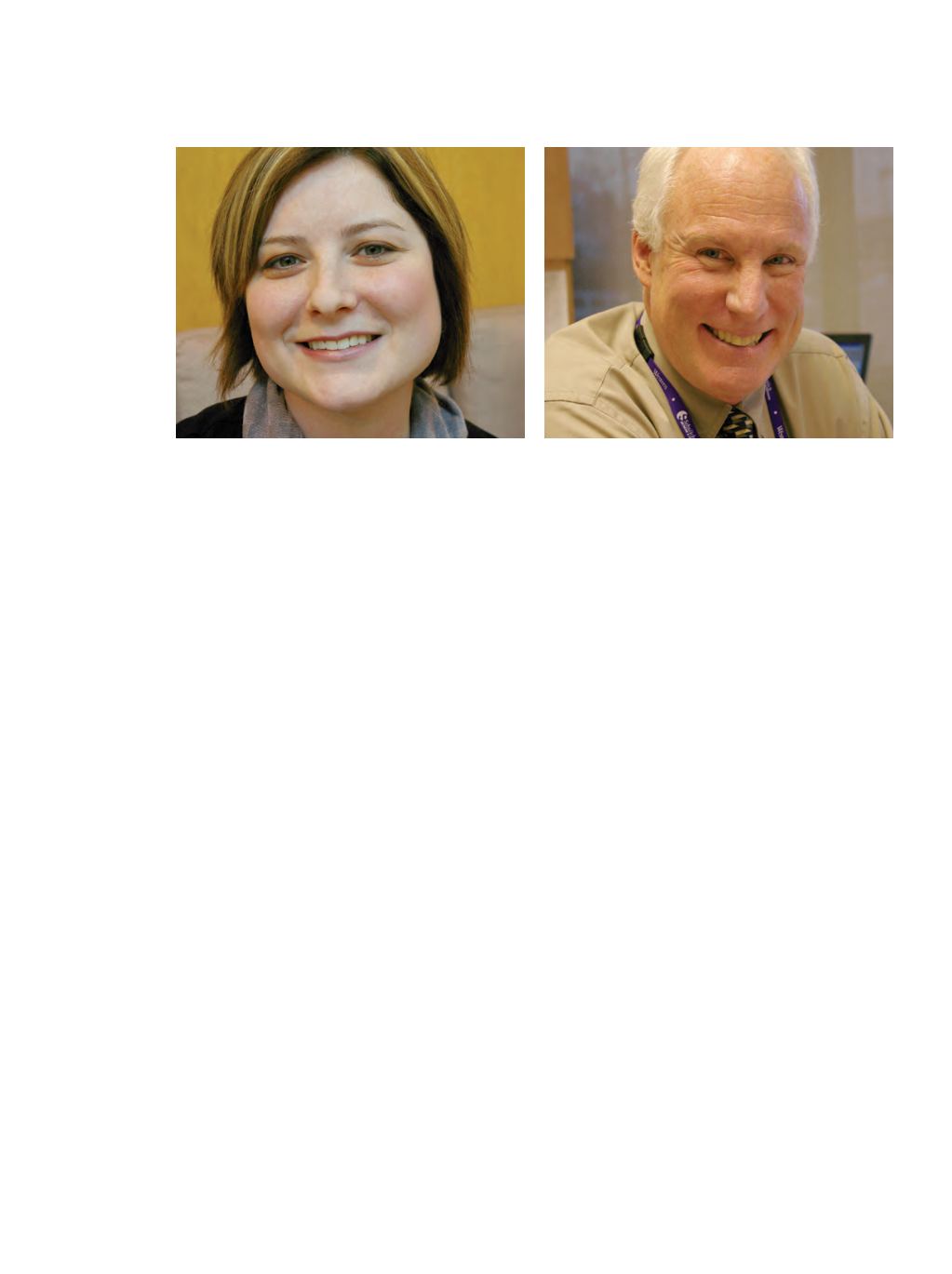
Medical student Stephanie Miskin, BEd ’08
Dr. Gerry Cooper, associate dean, Windsor Program


