|
|||



| home |
| application information |
| application procedure |
| visa & bar requirements |
| courses & faculty |
| student news |
| student achievements |
| our students |
| advisory board |
| contact us |
| FAQ |
| links |
|
OCTOBER 2004 AZRA HAQUE '05 REPRESENTS UNITARIAN UNIVERSALIST UN OFFICE Azra Haque, a third-year J.D./LL.B. student at the University of Detroit Mercy School of Law, missed a good chunk of classes in September, but she had a good excuse. Haque represented the Unitarian Universalist UN Office at the Third Session of the Assembly of States Parties of the International Criminal Court (ICC) at The Hague from September 2-10. The ICC came into being in July of 2002, and this session of the ASP was the annual meeting of the member states (States Parties) of the ICC, along with observer countries and interested non-governmental organizations (NGOs). The ICC was created to end impunity for crimes, end conflicts, remedy the deficiencies of Ad Hoc Tribunals, and to take over when national criminal justice systems were unwilling or unable to act. The crimes that are currently under the ICC's jurisdiction are genocide, crimes against humanity, war crimes, and eventually when it is defined, the crime of aggression. In order for the ICC to have jurisdiction, a country must have signed onto the ICC or the crime must have been committed on the territory of a country which has signed on to the ICC. Even then, the ICC is complementary to national judicial systems and will only step in if a domestic court is unwilling, or unable, to prosecute. To date, no one has been prosecuted, but investigations have begun into heinous crimes in Uganda and the Democratic Republic of Congo. "It (the ICC) is a new court so it will be awhile before the current investigations lead to trials," said Haque. "Also, the crime of aggression is still to be defined. The ASP hopes to have a definition by 2009, because an amendment to the statute can only be made seven years after the court comes into being. A lot of work remains to be done but it's still amazing to see how quickly the Court has become functional." With UDM's help, Haque was able to work as a program associate for the Unitarian Universalist UN Office. Haque was granted a summer stipend through the law school's Public Interest Fellowship Program. The Unitarian Universalist is a non-governmental organization (NGO) office located across the street from and affiliated with the United Nations in New York. "I had a great summer," Haque said. "I had a UN pass, so I could go to most of the UN meetings. I saw the UN General Assembly vote on a resolution regarding the illegality of the wall that Israel is erecting in the occupied territories. I also went to the UN sponsored Conference on Anti-Semitism and other meetings related to the International Criminal Tribunals for Rwanda and the former Yugoslavia. It was amazing to watch history being made." Haque spent a good portion of her summer researching the ICC. That's why her supervisor decided to send her to The Hague. Haque, who will graduate this May from UDM, has taken an interesting route to law school. She was born in India, grew up in the United Arab Emirates, attended the University of Georgia, moved to Maryland, and then settled in Canada before attending law school. Her experiences this summer have only solidified her intention to have a legal impact on a global level. "I am interested in practicing international law, and I hope two degrees from two countries will give me a competitive edge in a very competitive field," she said.
NOVEMBER 2003
The Centre of Refugee Studies, a research unit of York University in Toronto, has selected papers by Kathleen Andrew and Christina Chen to be presented at its conference, "Borders, Perspectives and Emerging Lives: Exploring Subjectivities in our Work". This conference will take place at York University on October 17. Both students are in their third year of the joint J.D./LL.B. Program of the University of Windsor and the University of Detroit Mercy. Kathleen's paper is titled "The Safe Third Country Agreement: Anticipated Impacts on Human Security, Family United and Forum Shopping". This paper deals with the US-Canada "safe third country" agreement to restrict refugee flow between the countries. Christina's paper is titled "A Comparative Study: Women Seeking Asylum Based on Membership in a Gender-Based Particular Social Group in the United States and Canada". This paper deals with US and Canadian standards for the recognition of women who have been abused under the legal definition of "refugee". Kathleen and Christina are among
the 19 students selected from universities in Canada, the U.S. and
the U.K. Each student will be part of a panel and will present her
paper for 10-15 minutes and then field questions. Both papers will
also be published by the CRS. |
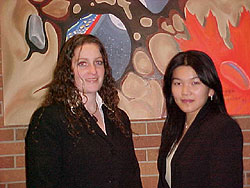 PRESENTATION
OF PAPERS AT THE CENTRE OF REFUGEE STUDIES, YORK UNIVERSITY
PRESENTATION
OF PAPERS AT THE CENTRE OF REFUGEE STUDIES, YORK UNIVERSITY