view . spring 2013
25
“The University has invested a lot of resources into
the preservation of these materials. We are recognized
as having the same level of importance as the Computer
Centre,” Owens says.
From programs for every convocation ever held on
campus, to yearbooks from UWindsor’s predecessor
Assumption College, the archives hold countless pieces of
both the University’s and surrounding region’s history.
Some prized documents include an 18th-century
document written in heavily cursive French. Owens, who
wears a pair of protective cotton gloves when holding
such fragile documents, reveals that it is a 1780 agreement
between chiefs of the Wyandot nation and the Jesuit
missionary, Reverend Father Pierre Potier. The document
outlines the terms of the chiefs giving the priest the
approximately 117 metres of land on which the University
of Windsor stands today.
Large, framed and good as new, the second piece is
a charter granting the adolescent University of Windsor
its very own coat-of-arms. Presented to then-president
Reverend Eugene LeBel in 1964, it bears the University’s
motto “Bonitatem, Disciplinam, Scientiam” (“Goodness,
Discipline, Knowledge.”)
To obtain these and other historical records, Owens
and assistant Ana-Maria Staffen BEd ’87, have reached out
to various campus departments as well as members of
the community. Their diligent work means that students
and faculty members can easily access records for
original research.
“We’re more than history,” says Owens. “We’re every
discipline. Students and faculty from here and all over the
world, such as Finland, Japan and even New Zealand, visit
us. This shows that the materials we have do not exist
anywhere else on the planet.”
As a young man in Alberta, Owens developed a passion
for social memory, compelled by the social movements
of the 1960s and particularly, the Canadian Centennial of
1967. “I wanted to understand Canada’s future through its
past and to preserve documents as my own contribution to
this,” he recalls.
With his wealth of knowledge, Owens began archival
work at the University in 1994. As well as living his passion
by caring for these unique materials, the archivist says that
he is helping to develop a new discipline necessary for
present times—preserving electronic correspondence
and data.
The advent of the digital communication age presents
some issues for archivists though, says Owens. “Archivists
and IT experts are still trying to design a reliable system for
preserving modern data. The challenge is that technology
is still not consistent enough to make this possible.”
Emails could be considered old-fashioned in 50 years,
he says, and unless print versions exist, families and
historians may never see those emails offering good wishes
or simple reminders.
“All of these technologies are fantastic for immediacy
but not for the preservation of memories. Our answers
to this may be perceived as old-fashioned, but they are
guaranteed to last,” Owens says.
Just as Father Potier was keeper of the land the
University rests on, Owens is the modern-day keeper of its
heritage and traditions. With the archivist’s dedication, it will
be easier to tailor the future with the threads of the past.
n
v
Chantelle Myers is a fourth-year Communication Studies, Media
and Film student.
“THE ADVENT OF THE
DIGITAL COMMUNICATION
AGE PRESENTS SOME
ISSUES FOR ARCHIVISTS.”
DR. BRIAN OWENS
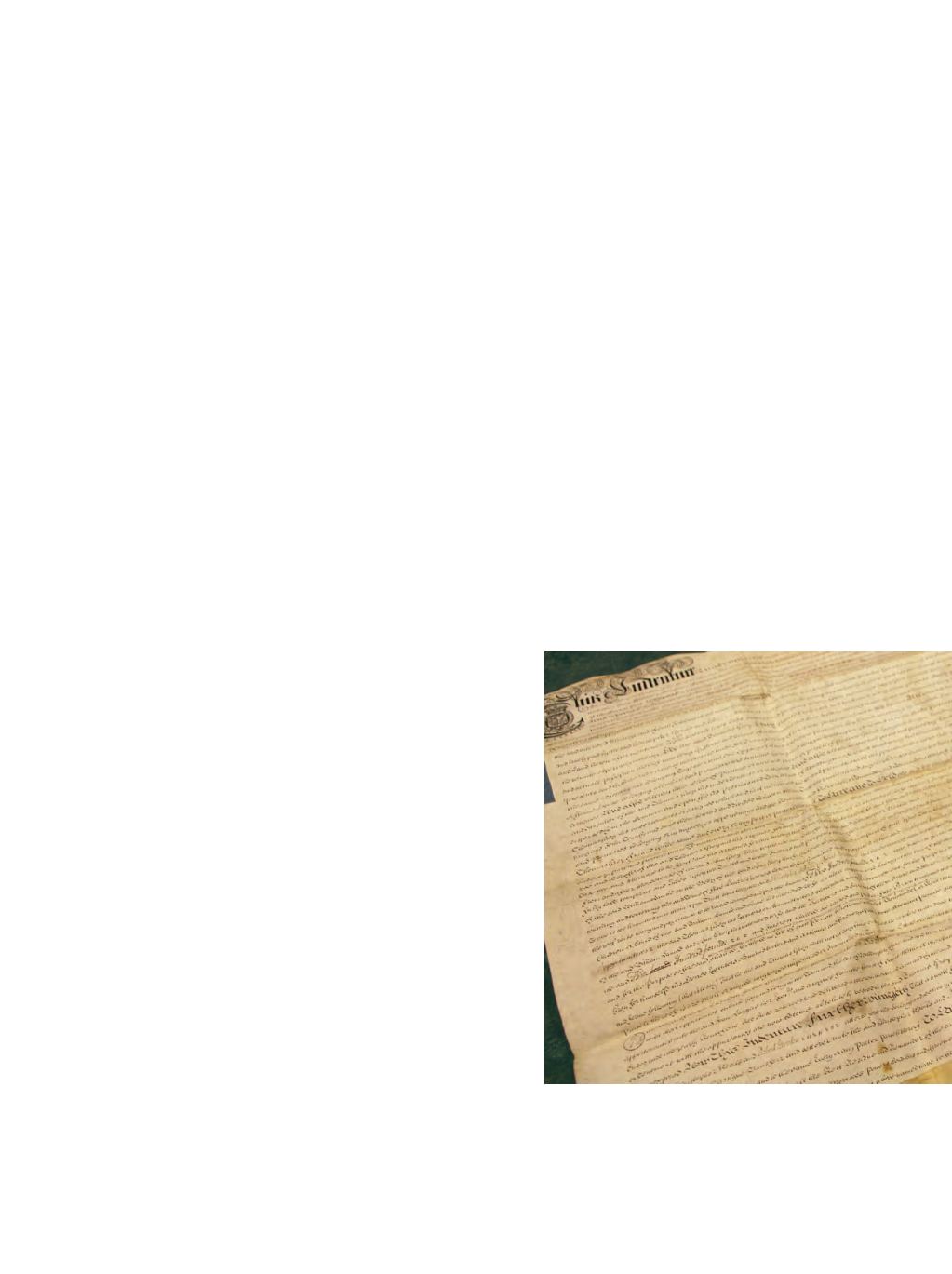
A prenuptial agreement from 1728.


