view . summer 2010
15
likely we’d see today a standard ‘slab and cage’ pedestrian
bridge above Huron Church road near Assumption High
School. Instead, the Green Corridor effort was instrumental
in pushing for a custom-designed bridge with unique
aesthetic and integrating planting and the potential to be
adapted for more green technologies.”
The introduction of the VABE program, he adds, is
another “hopeful sign to the region that the University
wants to be a leader in thinking about the form and
function of our built environment.”
The School is also a player in the development of the
city’s cultural master plan. The consultants of a recent
150-page, $110,000 study recently tabled at city council
invited the School to its first stage of study and faculty
members were present at a community meeting later.
The VABE program, which completed its first year
in 2009-10, and its reception by faculty and students
“speaks well of the vibrant and encouraging environment
promoted in the School,” says program co-ordinator
Dr. Veronika Mogyorody, an academic architectural
advisor who was also involved in the construction of the
new $24-million Medical Education Building on campus
and who is a part of the construction of the University’s
$112-million Centre for Engineering Innovation.
The collaboration with University of Detroit Mercy
and School of Visual Arts “has encouraged strong linkages
between art and architecture,” she adds.
The Detroit-Windsor connection was also the driving
force behind the Border Culture course that Lee Rodney
developed as part of the “visual culture” offerings at the
School. Rodney says the course “asks students to read
their immediate environment in terms of how the Canada-
US border is marked or signified in the greater Detroit-
Windsor region both in the contemporary moment and
over a longer historical period.” It examines how the border
manifests itself in a region that is different from other parts
in the world.
Meanwhile, the life forms that Tokio Webster
literally turned into art in a Petri dish came out of Bio-
Art, a contemporary art program that’s topic-driven,
interdisciplinary, collaborative and research-based, the kind
of offering that its founder, Jennifer Willet, says flourishes in
an intellectual centre like Windsor. She set up the country’s
first Bio-Art program after meeting with artists who started
a similar program in Perth, Australia, and developed it as
part of her BIOTEKNICA project on which she worked with
Shawn Bailey at the University of Concordia.
The School of Visual Arts will keep up with trends
and thought in contemporary art, its director says. It will
probably keep transforming, as it has throughout its history,
in response to the needs of educating young artists. While
Pelkey says interdisciplinary programs will likely grow, she
adds that it won’t be at the expense of sacrificing the depth
or meaning of its traditional disciplines, or taking away from
its bedrock of “intellectual engagement” with students.
As for the rest? “It’s only going to get better,” Pelkey
promises with a wry smile.
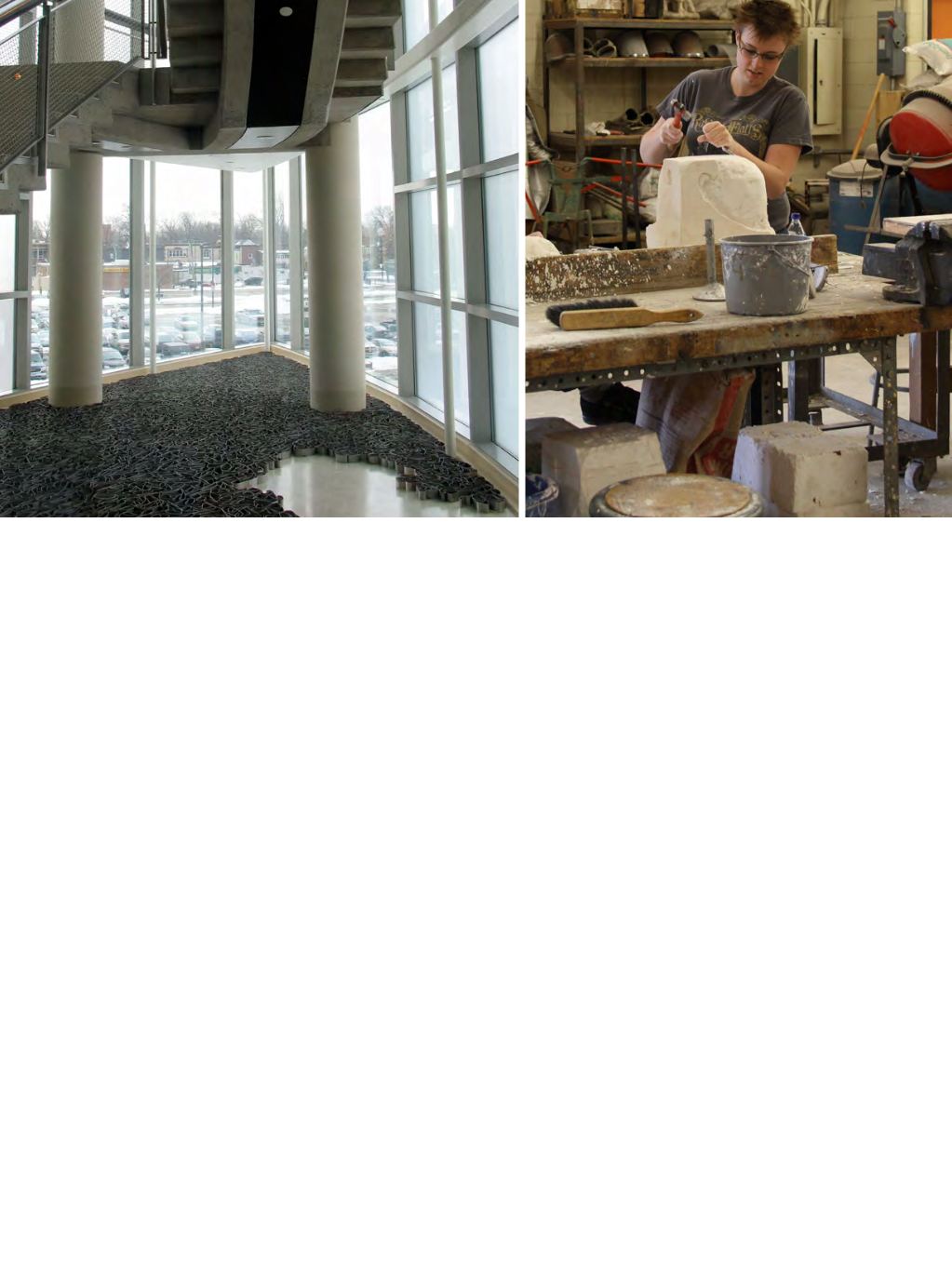
5. An installation at the Art Gallery of Windsor by Dan Berynk BFA ’09, Major: Visual Arts, Minor: Communication Studies; 6. A visual arts student sculpts.


