14
view . summer 2010
“Whether in partnership with other academic
institutions in Detroit or working with Artcite or the Art
Gallery of Windsor,” Hébert notes, “the School of Visual
Arts has, for many years, fostered important development
in the community by providing great programming, much-
needed resources and strong professional engagement.”
From the beginning, School founder Joseph DeLauro
and the young faculty he hired set out to establish
a program that was “very focused” and had a “very
intense studio program,” recalls Bill Law, among its early
professors. He called that type of training, based on
the rigorous standards of art schools throughout North
America at the time, very unusual for a university program.
The School has always been a close community,
delivering what director Brenda Francis Pelkey calls
“almost a personal education, where people actually care
about you – they know you as an individual.” Its emphases
on skill development and conceptual thinking and large
storage spaces, for instance, has enabled students to “think
big” and create “some amazingly ambitious projects” –
even at an undergraduate level –that serves them well at
the graduate level, she adds. She points to Dan Bernyk’s
2009 work at the AGW that is made from thousands of
objects interlocked on the floor as just one example.
The School’s links to the wider community include the
annual exhibit of high school art works and MFA students
show at the AGW. There are also outreach projects like
Green Corridor’s innovative public art Open Corridor
festival, a drive-through gallery that generated artwork
addressing environmental issues centred on the busy cross-
border traffic corridor. Faculty have also left their mark,
from Susan Gold Smith’s involvement in community events
like MayWorks to Mike Farrell’s public lectures, “Art Bus”
tours to the U.S. and European trips with students, and Lisa
Baggio’s spearheading a fundraising drive that raised more
than $40,000 to renovate the School’s LeBel Gallery.
Pelkey says a “vibrant art school is possible when
you’ve got faculty who are actively engaged in producing
art themselves.” She points to such esteemed artists
as Iain Baxter& who has exhibited across Canada and
internationally as examples of faculty whose reputations
extend far and wide.
Pelkey says the interdisciplinary nature of the School’s
programs is perhaps a product of the border culture and
the kind of community that conceptualizes things in
ways that is different from a city that’s centrally located
and “bound very tightly by its history.” She often uses
“transitions” as a description for the way the School has
developed over the years, and how Windsor, with its rich
and diverse ethnic communities, grows and flourishes.
“Certainly, in the past 15 years since I moved back
to Windsor, I have noticed the Visual Arts school’s
increasingly active participation in contributing to
Windsor’s appearance,” notes Jim Yanchula, manager,
urban design and deputy city planner for the City of
Windsor. “If it weren’t for the effort of the School, it’s very
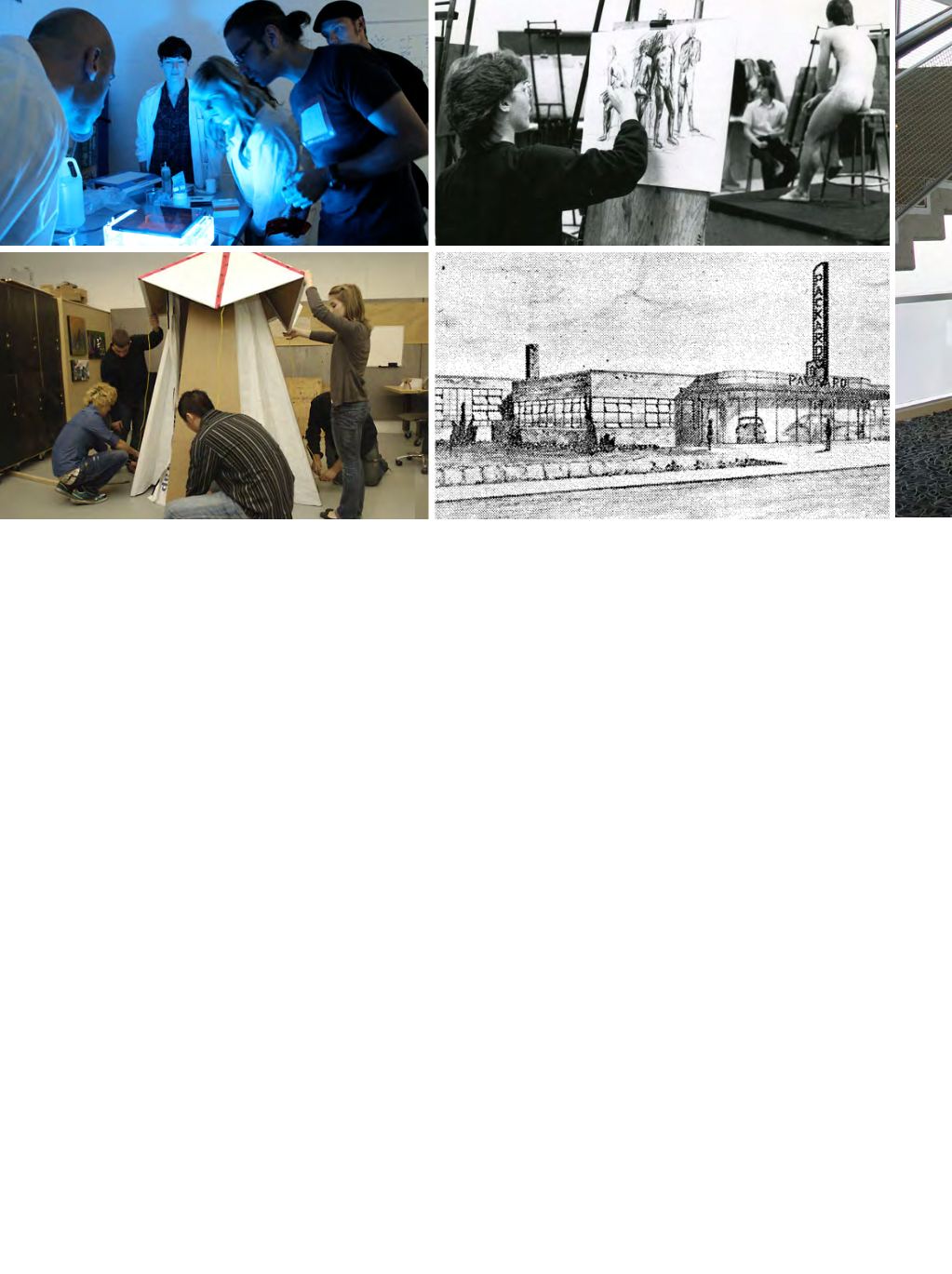
1. Visiting Artist Paul Vanouse teaches Gel Electrophoresis to Visual Arts students in Dr. Jennifer Willet’s Bioart: Contemporary Art and the Life Sciences class. (2009);
2. Life drawing course from the 1980s; 3. VABE students testing out a prototype of the temporary shelter they designed as a class project; 4. The LeBel building, which
was once a Packard showroom.


