view . spring 2012
11
In April 2011, when many university students were taking a
well-deserved break from their academic studies, Ugandan
border officials were blackmailing Katelyn Murray
.
On the last leg of her journey to
the Democratic Republic of Congo,
the fourth-year women’s studies and
social justice student and her travel
partner found themselves held up
by a border guard demanding $250
to allow them to continue to their
destination. With fingers crossed,
they began making phone calls to
Ugandan friends.
Kate Murray’s journey to reach
Lukanga, Congo, began one year
earlier in April 2010 when she read
a profile of Jonathan Busiku, a
Congolese immigrant, written by
Dennis Porter, from Windsor. She then
met Porter and Busiku at an outreach
event for War Child’s Windsor chapter,
for which she served as president.
The story of Busiku, an educator
truly committed to fighting for human rights in his community
of Lukanga, convinced Murray to join him in founding the
organization, Kujali Congo.
“‘Kujali’ means ‘to care for’ in Swahili,” explains Murray, who
serves as the group’s director of fundraising. Its goal is to help the
residents of the rural village of Lukanga who are trying to rebuild
their lives after two wars.
The First Congo War, from November 1996 to May 1997, was a
revolution in Zaire that displaced its president. The Second Congo
War began in August 1998 and officially ended in July 2003, though
hostilities continue to this day. By 2008, the war and its aftermath
had killed more than six million people, mostly from disease and
starvation, making the Second Congo War the deadliest conflict
worldwide since World War II.
Among the many casualties was a generation of children for
whom education had become unreachable.
That’s where Kujali Congo hopes to make a difference.
“There is a famous quote by
Edward James Olmos, ‘Education
is a vaccine for violence’,” she says.
“Our long-term goal is to educate
individuals in Canada on how to learn
more about the issues faced by the
Congolese people, and especially to
empower women on the ground.”
Her own sense of social justice
awakened in high school. “I had
some inspiring teachers who were
committed to educating you on world
issues. In Grade 12, I went to West
Africa with Rotary Club. It opened
my eyes to the different way of life in
other communities.”
Murray’s interest led her to enrol
in the University of Windsor’s joint
program in women’s studies and
social justice.
“Addressing challenges in international development requires
an interdisciplinary approach. Social justice and women’s studies
are excellent interdisciplinary programs which have encouraged
me to think critically and creatively in order to help solve
complex problems.”
Kujali Congo works towards the promotion of education at all
levels. Significant obstacles block the way though, says Murray. The
Congolese economy is shattered, the government provides no funds
for education, and the political environment continues to be precarious.
In some cases, rebels have kidnapped young people, or youths have
simply chosen to join them, believing they have no alternatives.
“I’ve been told of brave individuals in the local communities
who have actually gone to the rebel camps to negotiate the release
of the children,” says Murray.
KUJALI CONGO
Sowing the seeds of hope
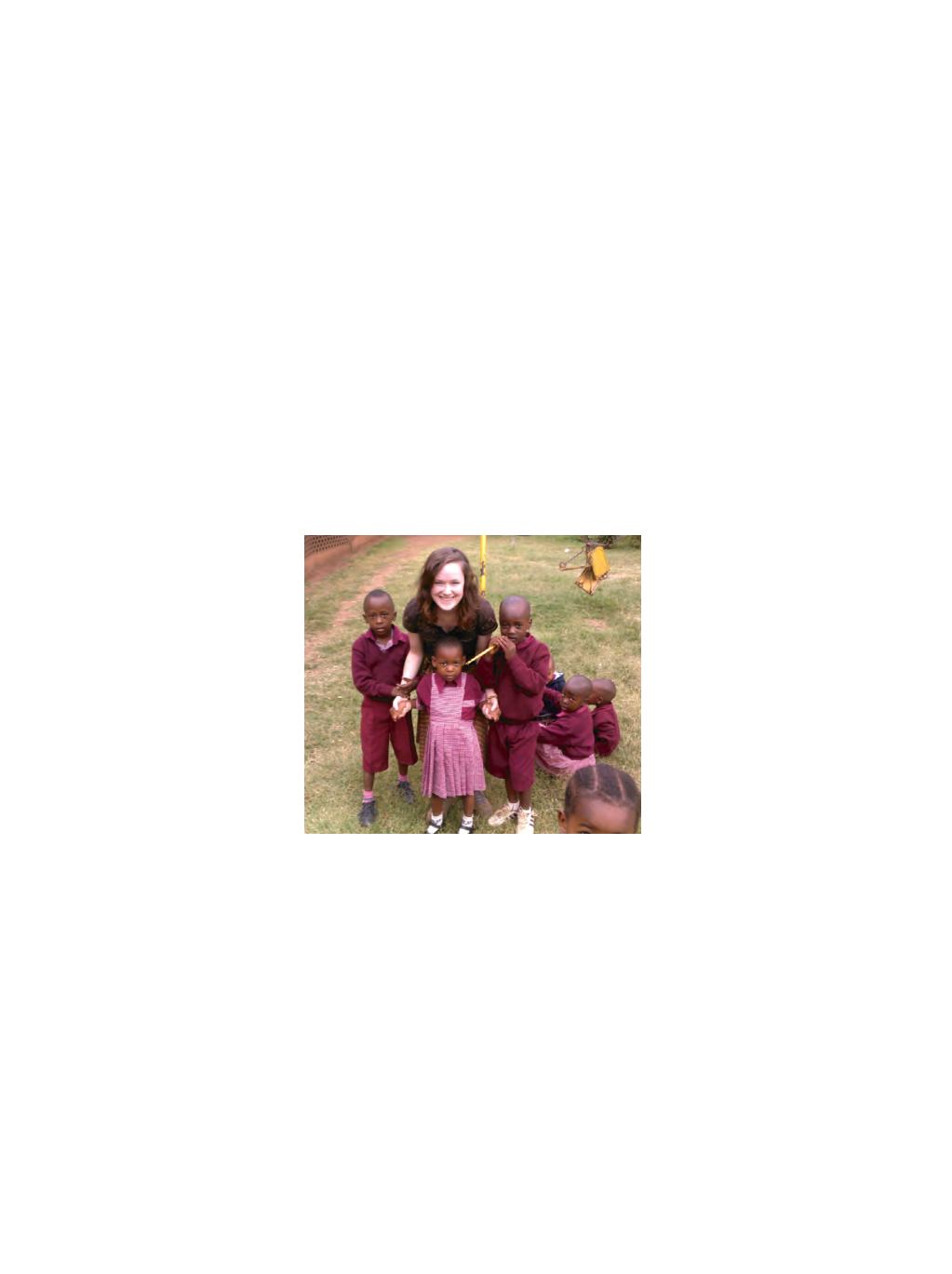
For many Congolese children, education has become an
unreachable goal. Above: Katelyn Murray with village youngsters.
STUDENT PROFILE
BY JENNIFER AMMOSCATO


