20
view . summer 2011
How are other UWindsor research projects creating
value for society? Below are several examples.
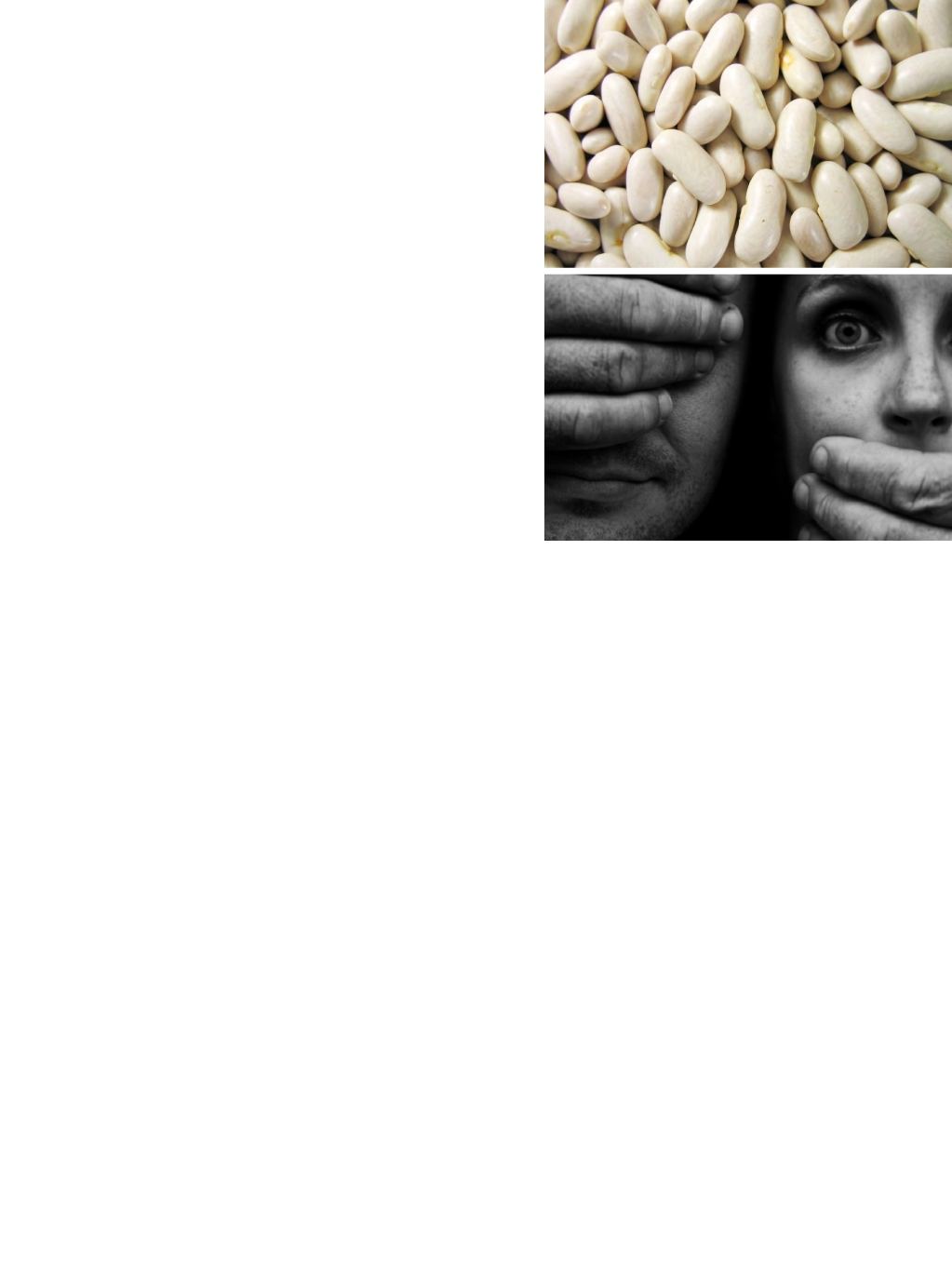
BUILDING A BETTER BEAN
Biology professor Bill Crosby would love to see the
day when common navy beans are used to make
everything from steering wheels to prosthetics.
Dr. Crosby is a partner in an $11-million, tri-university
project to develop a draft genome sequence for dry beans,
much the same way the Human Genome Project identified
the 25,000 genes found in the human body.
That’s crucial information in order to make a more
disease-resistant bean. Currently, 10 to 40 per cent of Ontario’s
$100-million crop is lost to bacterial pathogens such as blight.
Reducing the amount lost to disease will increase the amount
to be used to develop plastics and biodegradable products.
Crosby will gather all the genetic data collected by
the other researchers, organize it at the University’s high
performance computing facilities, and analyze it for quality
and validity.
“This is one of the first large-scale agricultural bio-
renewable projects that has come to UWindsor.”
Genome Canada is funding the project.
HELPING VICTIMS OF VIOLENCE FIND
RELIEF
They may look at the problem through eyes defined
by different disciplines, but Patti Fritz and Betty
Barrett are united in their goal of conducting
research that will ultimately provide greater relief to
the far too many victims of violence in relationships
between those who are married, living together,
dating or are romantically involved.
“The greater goal is prevention and intervention,” says
Dr. Fritz, an assistant professor in psychology who studies
the effects of cyber-bullying on its victims. Fritz is utilizing
communications technology and on-line social networking
to examine whether victims of intimate partner cyber-
bullying are likely to experience psychological problems.
Dr. Barrett, an assistant professor in social work and
women’s studies, examines how women from diverse
cultural backgrounds and those in same-sex relationships
who are victimized by violence seek help from the police
and social service agencies such as shelters. Her goal is to
provide data to better inform those agencies on how best
to respond to a wide diversity of cultural needs.
“If we want agencies to be better responders to women
in crisis situations, we need to know what those victims
want,” says Barrett. “You can create all the shelters you
want, but if they’re not culturally responsive, people aren’t
going to use them.”
BATTLING HARMFUL INVASIVE SPECIES
The tiny zebra mussel might seem relatively harmless.
Aquatic invasive species of its ilk are responsible,
however, for billions of dollars in lost revenue for
industries such as shipping and fishing.
Under the direction of Dr. Hugh MacIsaac, a professor
at the Great Lakes Institute for Environmental Research, an
army of scientists at institutions across the country will
combat the growing problem of invaders such as sea
lamprey, Asian carp, zebra mussels, round gobies and the
spiny water flea in Canada’s rivers, lakes and coastal waters.
The researchers are part of the $6.5-million Canadian
Aquatic Invasive Species Network II. Funded by the
Natural Sciences and Engineering Research Council, the
network is continuing the work of its first phase, which
began in 2006, developing innovative early detection
technology and rapid response capabilities to identify and
manage invaders in marine and freshwater habitats.
“Invasive species are of concern in the Canadian
north, which is primed for new invasions as shipping traffic
increases and climate warming renders Arctic habitats
more suitable for invaders,” says MacIsaac.


